
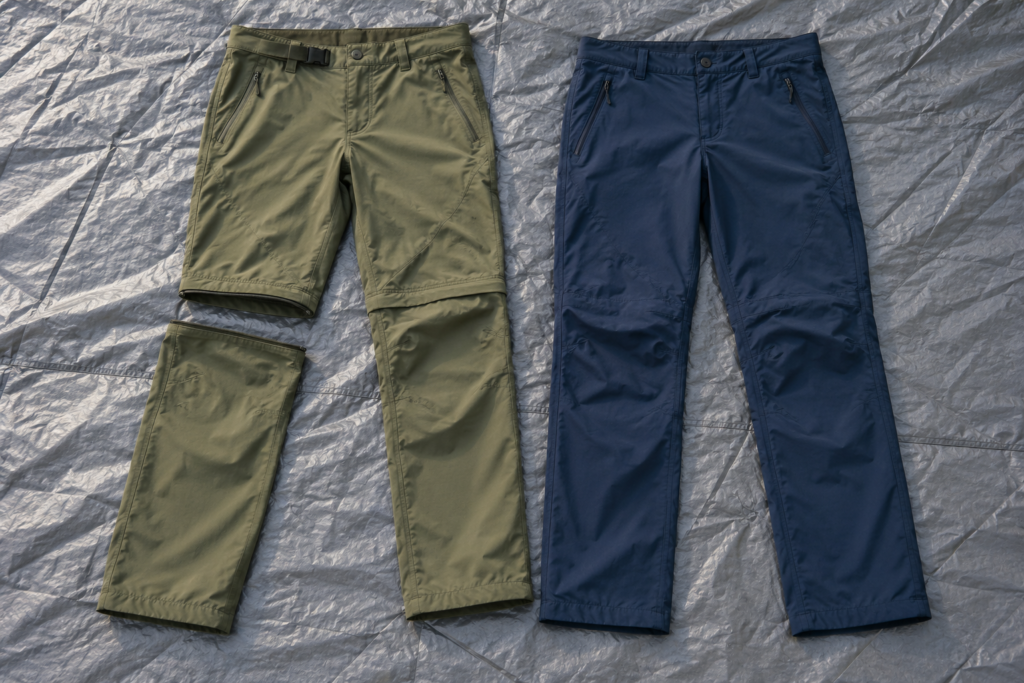
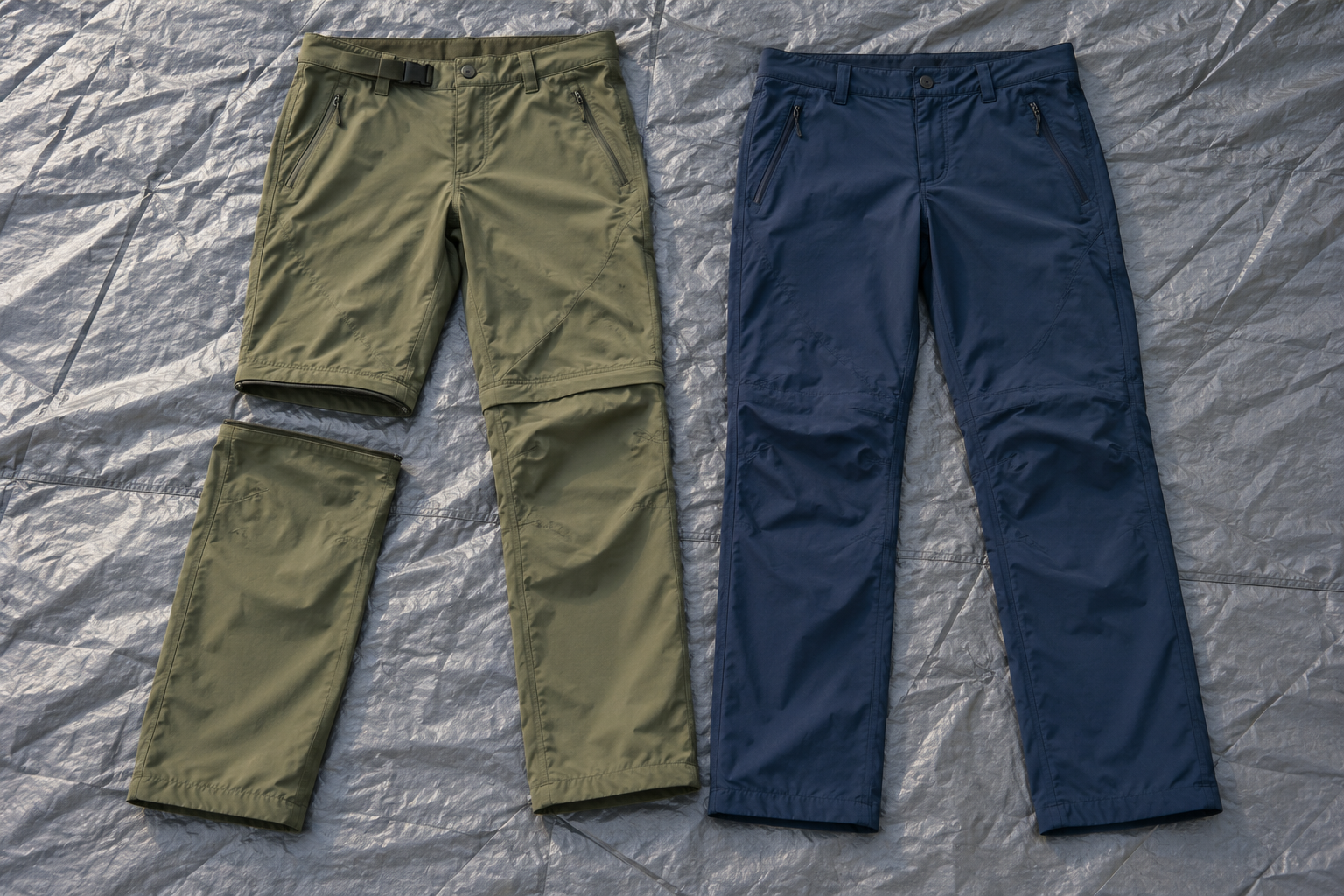
Quick verdict: Buy convertible pants when you regularly switch between trousers and shorts during an outing. Fixed-length pants are often enough when you keep your legs covered or rarely use the conversion; fit and fabric should decide before the zipper feature.
Research-based buying guide; no hands-on testing is claimed. As an Amazon Associate, Time to Get Outside earns from qualifying purchases.
| Decision | How the options compare |
|---|---|
| Main benefit | Convertible pants: One garment can become shorts Fixed-length pants: A simpler leg construction |
| Fit check | Convertible pants: Zip position, resulting short length and leg removal Fixed-length pants: Movement, inseam and preferred coverage |
| Value test | Convertible pants: You actually use both configurations Fixed-length pants: You would leave the lower legs attached anyway |
Start with how often you change clothing
Convertible hiking pants use removable lower-leg sections to become shorts. That can be useful on walks that start cool and become warmer, or for travel where you want one garment to do both jobs. It is less useful if your routine keeps you in long trousers throughout the outing.
Before buying, think about the last few walks you actually took. Would you have removed the legs, or would brush, insects, personal preference or the weather have kept them attached? A feature you never use is not automatically worth extra cost, even when the idea sounds versatile in a shop.
Fit the trousers and the shorts separately
Try the full-length garment while stepping, bending and sitting, paying attention to where the conversion seam rests. Then try the shorts configuration. The short length is determined by the design and can differ from the shorts you normally like. A well-fitting waist does not guarantee that both configurations are comfortable.
Check the process of removing the lower legs with your usual footwear. Some models make that easier than others, and an ankle opening is not proof that every boot can pass through it. If conversion requires more rearranging than you want on a normal walk, the feature may remain unused.
Fabric and pockets can matter more than zippers
REI’s buying guidance distinguishes pant type from fabric, fit and other features. Compare those decisions separately: a lightweight zip-off garment and a heavier fixed-leg garment are not a controlled test of conversion alone. Look at stretch, fabric feel, pocket access and the clothing you will wear underneath.
Columbia’s current Silver Ridge Utility examples illustrate how conversion details vary between cuts, including the resulting short configuration and zipper identification. Treat these as model-specific features rather than a promise that every convertible pant works the same way. Verify the actual model, cut and inseam shown in the seller’s listing.
When fixed-length pants are better value
Choose fixed-length pants when you mainly want dependable long-leg coverage and find a comfortable pair at a better total price. A suitable roll-up design may also meet your needs without fully detachable sections. Neither approach is universally cooler or more durable; those outcomes depend on the particular fabric and construction.
My recommendation is convertible pants for people who genuinely use both forms, and fixed-length pants when the full trouser is what they wear. Compare Canadian-dollar totals for the correct cut and inseam, and check returns before buying two sizes. Keep a well-fitting pair that already suits your walks rather than replacing it for unused versatility.
Compare current U.S. and Canadian listings
These buttons open product searches, not guaranteed stock or fixed prices. Match the exact model, size, included accessories and seller before ordering. Canadian shoppers should compare the final cost in Canadian dollars, including any shipping or import charges.
Related buying guides
- Merino vs Synthetic Base Layers: Which Should You Buy for Hiking?
- Short vs Tall Hiking Gaiters: Which Height Should You Buy?
- Best Rain Ponchos for Hiking, Camping and Sudden Showers
Sources and research notes
Specifications and guidance checked October 16, 2026. Recommendations are editorial judgments based on the cited details and use cases; they are not independent performance measurements.