
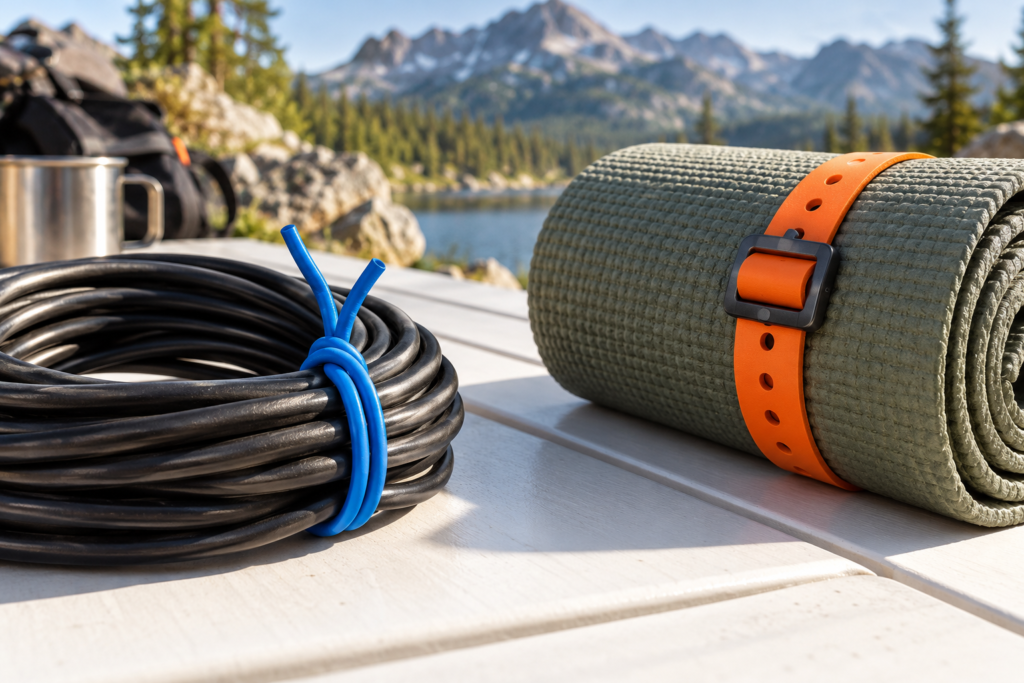
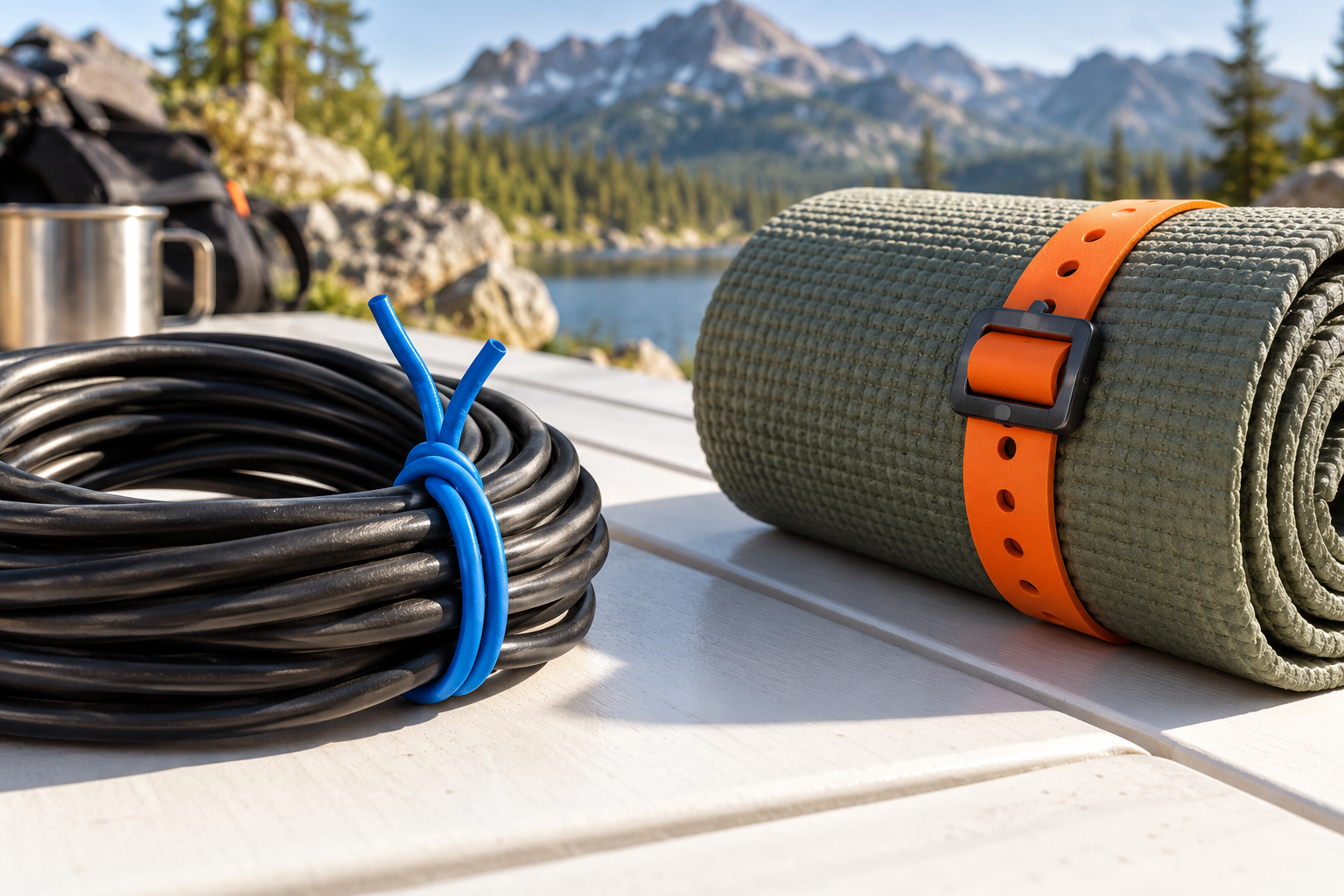
Quick verdict: Choose Gear Tie for reshaping around light bundles and everyday organization. Choose an appropriately sized Voile Strap when a tensioned buckle strap suits the equipment. Match the fastening job and usable circumference; neither product name establishes a load rating for your setup.
Research-based buying guide; no hands-on testing is claimed. As an Amazon Associate, Time to Get Outside earns from qualifying purchases.
| Decision | How the options compare |
|---|---|
| Fastening style | Gear Tie: Bendable wire inside a grippy rubber coating Voile Strap: Semi-elastic polyurethane strap with buckle |
| Useful job | Gear Tie: Cables and flexible light-bundle organization Voile Strap: Tensioning around appropriately matched gear |
| Before buying | Gear Tie: Length, surface and manufacturer warnings Voile Strap: Series, buckle and usable circumference |
Start with what needs to stay together
A cable coil, a rolled mat and a load mounted to a vehicle are different fastening jobs. Gear Tie and Voile Strap should not be treated as interchangeable simply because both wrap around equipment. Decide whether you need easy reshaping around a light bundle or a strap held under tension around an appropriate item.
For simple campsite organization, an existing suitable tie may already be enough. Buying an expensive collection of specialty fasteners before identifying the bundle sizes can leave you with several pieces that do not fit. Measure the equipment you intend to secure and consider how frequently you will open the fastening.
Where Gear Tie makes sense
Nite Ize describes Gear Tie as a bendable wire core with a grippy rubber exterior. That supports its role as a reusable wrap-and-twist organizer. It can be useful for keeping light items together or arranging cables without committing to a fixed buckle position.
The manufacturer explicitly states that the product is not weight rated and warns about sharp, hot or abrasive surfaces and shifting loads. Those limits belong in the buying decision. Do not turn its convenient shape into an assumed transport or load-security capability that the product does not claim.
Where a Voile Strap fits better
Voile’s polyurethane straps use a semi-elastic design to create tension around a suitable bundle. The range includes different lengths, widths and buckle styles, so a broad Voile Strap search can show products intended for different arrangements. Compare the exact series rather than treating every orange strap as the same item.
Read the usable circumference range as well as the nominal length. Buckle engagement and the path around the equipment affect the fit, so the headline length is not the amount of bundle circumference available. An unsuitable length can be poor value even when the material and fastening style otherwise fit the job.
Buy a small useful kit before a large assortment
For a camping bag, one or two correctly selected fasteners can be more useful than a large multipack in arbitrary sizes. Consider the surfaces they touch, access to the buckle or ends, and how you will inspect them. Replace damaged parts according to the manufacturer’s guidance rather than relying on appearance alone.
My recommendation is Gear Tie for convenient light-bundle organization and a suitable Voile Strap for gear that benefits from its tensioned strap arrangement. Use purpose-rated equipment when a particular load or application requires it. Compare Canadian-dollar prices per useful size, not merely per piece, and keep a simpler fastening when it already does the intended job.
Compare current U.S. and Canadian listings
These buttons open product searches, not guaranteed stock or fixed prices. Match the exact model, size, included accessories and seller before ordering. Canadian shoppers should compare the final cost in Canadian dollars, including any shipping or import charges.
Related buying guides
- Camping Gear Repair Kit vs Duct Tape: What Is Worth Carrying?
- Camping Storage Bin vs Hanging Organizer for Car Camping
- Camping Chair Carry Bag vs Shoulder Strap: Which Travels Easier?
Sources and research notes
Specifications and guidance checked October 16, 2026. Recommendations are editorial judgments based on the cited details and use cases; they are not independent performance measurements.