
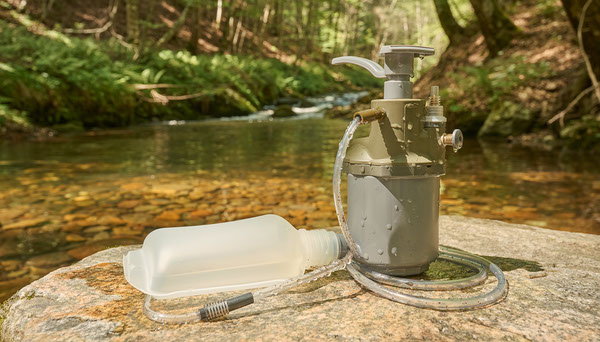
Quick verdict: Choose a treatment system for the hazards in the water, rather than assuming a filter and tablets are interchangeable. A suitable filter can remove specified organisms and particles; a compatible disinfectant can address additional germs when used correctly. Safe carried water may remove the need to buy either for a short walk.
Research-based buying guide; no hands-on testing is claimed. As an Amazon Associate, Time to Get Outside earns from qualifying purchases.
| Decision | How the options compare |
|---|---|
| How it works | Portable filter: Physically removes what its rating covers Disinfection tablets: Uses the specified chemical and contact time |
| Useful feature | Portable filter: Can clarify water and remove rated organisms Disinfection tablets: Compact treatment or backup component |
| Key limitation | Portable filter: Many microfilters do not remove viruses Disinfection tablets: Effectiveness depends on chemical, organism and conditions |
| Buying check | Portable filter: Verified removal claims and care instructions Disinfection tablets: Intended drinking-water use, expiry and complete label |
Start with the source, not the smallest package
Clear-looking water can still contain germs. The CDC recommends boiling to kill germs and identifies filtration followed by disinfection as another treatment approach when correctly performed. It also warns that boiling or disinfection cannot make water containing harmful chemical contamination safe.
That means a buying guide cannot declare one tablet or filter suitable for every stream. Assess the source and follow relevant local guidance. When a short outing allows you to carry enough safe drinking water from the start, that can be simpler than arranging treatment on the trail.
What to check on a filter
Read its actual removal claims. A microfilter rated for bacteria and protozoa should not be assumed to remove viruses. A carbon stage advertised for taste does not establish broad protection from microorganisms or every chemical hazard.
Check how the device is cleaned, how clean and untreated water are kept separate and whether it has temperature-sensitive components. A lightweight filter is only useful if you can maintain the required condition throughout the trip. Follow the maker’s instructions after suspected damage rather than judging function by the fact that water still flows.
What to check on tablets
Choose products explicitly intended for drinking-water treatment. Read the chemical type, supported organisms, water-volume instructions, temperature considerations and required contact time. Tablets with different active ingredients should not be treated as interchangeable just because their packets look similar.
Inspect expiry and packaging before packing. Work out how much water the intact supply can treat under its own instructions. A small emergency packet may be useful redundancy while being inadequate for a group’s entire multi-day supply.
Why the two can be complementary
A suitable filter can handle its rated organisms and improve clarity, while an appropriate follow-up disinfection step addresses the hazards its label covers. The steps still have to be compatible and performed correctly. Do not shorten a contact time because the filtered water appears clean.
For a particular route, an established purifier or a suitable boiling setup may be a more appropriate complete solution. Choose the method around source risks, volume and the manufacturer’s validated instructions rather than buying two products and assuming the combination covers everything.
Convenience has a real cost
Think about collection access, waiting time and how many clean containers you need. A fast filter may appeal to someone making repeated stops; a planned treatment wait may suit another routine. Your ability to follow the process consistently matters more than the catalogue weight alone.
Canadian shoppers should check local product availability and the exact label supplied. Avoid taking a marketplace description as the final treatment instruction. If source safety is uncertain, use a known safe alternative and seek authoritative local guidance rather than relying on the appearance or taste of the water.
Final buying recommendation
Buy verified treatment capability and a process you can follow. A filter and tablets often serve different roles. Skip unnecessary treatment purchases for a short walk when adequate safe carried water already meets the plan.
Compare current U.S. and Canadian listings
These buttons open product searches, not guaranteed stock or fixed prices. Match the exact model, size, included accessories and seller before ordering. Canadian shoppers should compare the final cost in Canadian dollars, including any shipping or import charges.
Related buying guides
- Best Portable Water Filters for Camping and Emergency Kits
- Sawyer Squeeze vs MINI: Which Water Filter Should You Buy?
- Squeeze Water Filter vs Pump Filter for Hiking: Which Is Better?
Sources and research notes
Specifications and guidance checked October 15, 2026. Recommendations are editorial judgments based on the cited details and use cases; they are not independent performance measurements.