
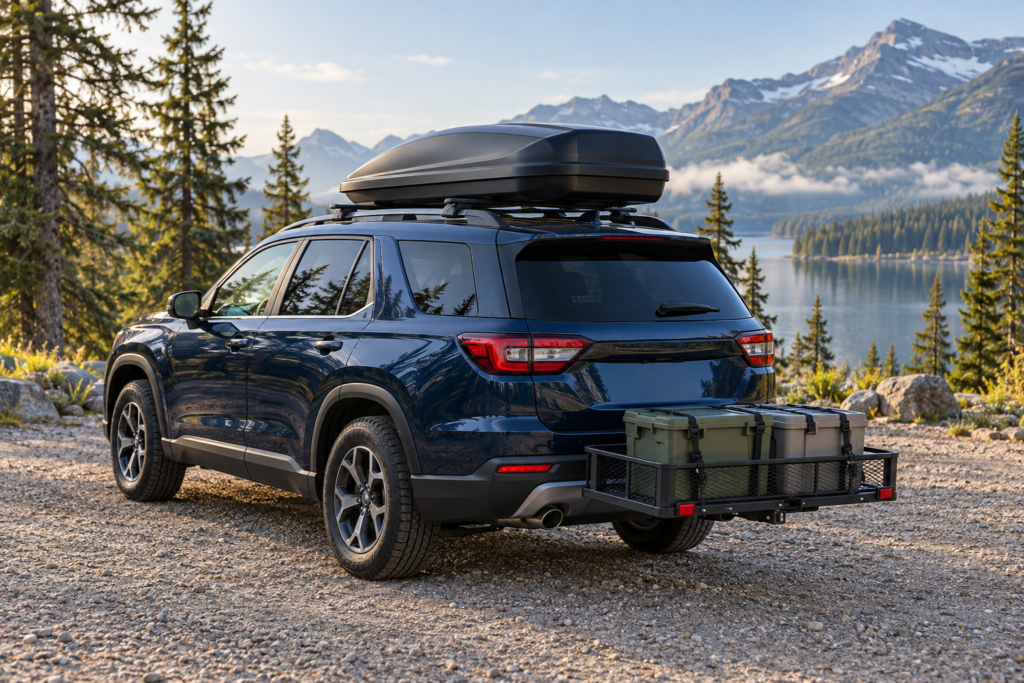
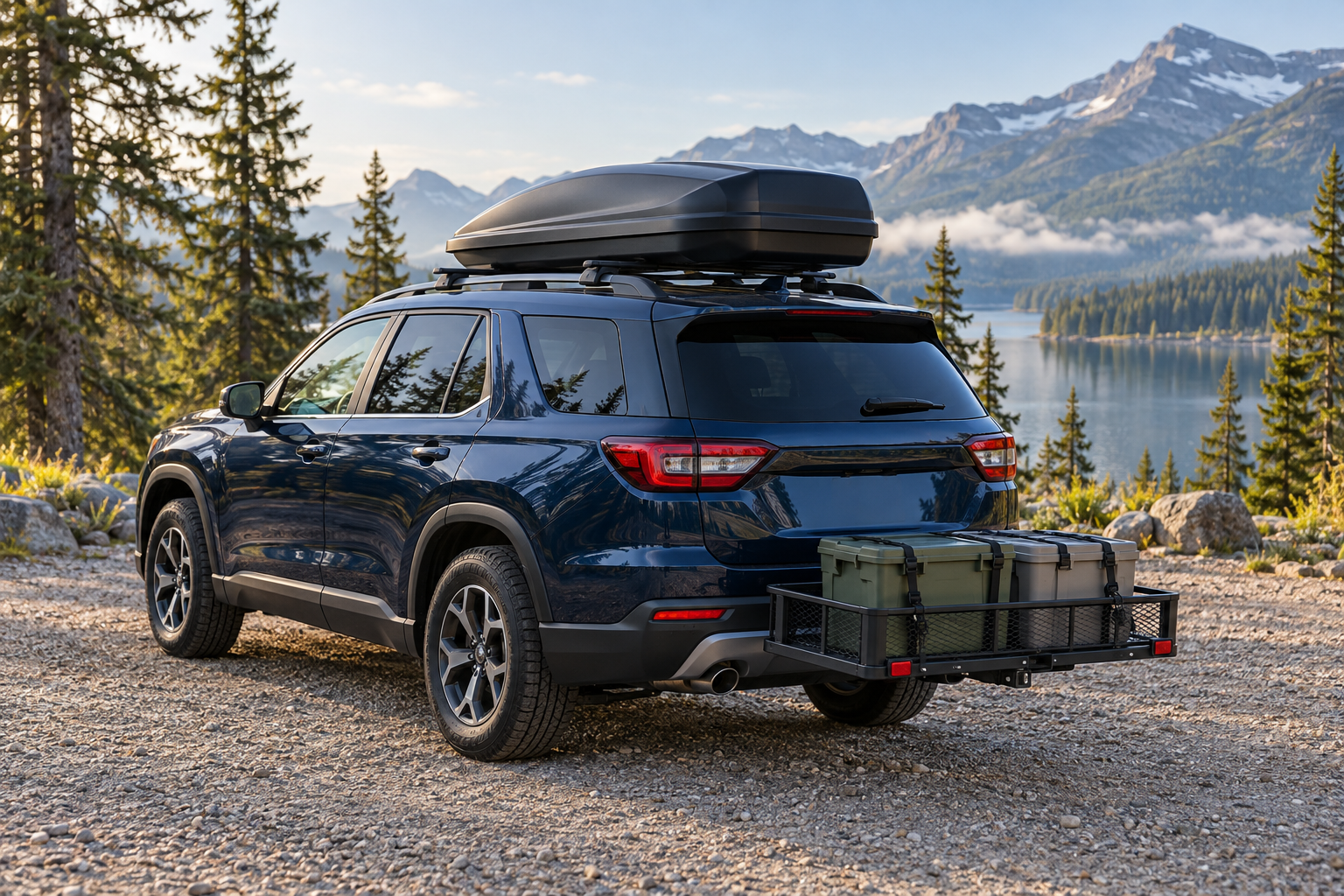
Quick verdict: Choose a roof box for compatible rooftop storage when you can load it comfortably and manage the extra height. Choose a hitch carrier when rear loading and the vehicle’s approved hitch setup suit your gear. Verify every vehicle, rack and carrier limit before comparing storage volume.
Research-based buying guide; no hands-on testing is claimed. As an Amazon Associate, Time to Get Outside earns from qualifying purchases.
| Decision | How the options compare |
|---|---|
| Loading position | Roof cargo box: Above the vehicle Hitch cargo carrier: Behind the vehicle |
| Main constraint | Roof cargo box: Roof compatibility, overhead lifting and added height Hitch cargo carrier: Hitch compatibility, rear clearance and permitted load |
| Weather protection | Roof cargo box: Depends on the exact enclosed box Hitch cargo carrier: An open basket differs from an enclosed cargo box |
| Whole-system check | Roof cargo box: Vehicle, rack, box and payload Hitch cargo carrier: Vehicle, hitch, carrier and payload |
Start with the vehicle you own
A cargo carrier adds space, but it does not increase the vehicle’s permitted weight limits. Check the owner’s manual and the carrier maker’s fit information for the exact vehicle and hardware. A product advertised as universal still has mounting and loading requirements.
Thule’s guides distinguish rooftop storage from rear-mounted carriers and emphasize compatibility and load limits. Use that as a purchasing framework. The final instructions must come from the specific vehicle, rack or hitch and carrier you will combine.
When a roof box makes sense
A roof box is useful when appropriate crossbars and roof capacity are available and the gear suits the box’s dimensions. Bulky bedding can be a more practical rooftop load than heavy items you struggle to lift overhead.
Include the weight of the rack and empty box when calculating available capacity. Respect every applicable component limit, including the vehicle’s dynamic roof rating for driving. A roof’s parked-load capability should not be substituted for its moving-vehicle limit.
When a hitch carrier is worth considering
A rear carrier can make loading more accessible and leave the roof available for another appropriate use. It is worth comparing when overhead loading is the main annoyance, provided the vehicle and hitch support the exact setup.
Check the carrier’s empty weight and cargo together against the relevant limits. Receiver fit alone does not establish suitability. Extensions, adapters or a swinging mechanism can add requirements or change allowed loads; use only combinations the manufacturers approve.
Clearance and access can decide the purchase
A roof box increases total vehicle height. Measure the complete setup and account for garages, low structures and other overhead obstacles. Check rear-hatch clearance too, especially with a long box.
A rear carrier adds length and can affect ground clearance, tailgate access and the view from a reversing camera. Verify required visibility of lamps and identification and the applicable local requirements. Do not assume an empty parking-space fit tells you how the loaded setup behaves on a sloped entrance.
Open baskets and enclosed boxes are different
An open hitch basket does not provide the weather protection of a suitable enclosed box. Include approved cargo restraint and any suitable protective arrangement in the budget. Keep every load secured according to the carrier instructions.
For Canadian road trips, consider rain, road spray and the storage conditions the gear needs. Compare the whole system price, including crossbars or hitch work where necessary. Also plan where the empty carrier will live at home; a bulky box can solve one storage problem while creating another.
Final buying recommendation
Buy roof storage for a compatible overhead system; buy rear storage for a compatible accessible loading routine. Skip either if reducing or reorganizing the camping load already solves the problem. More nominal litres are useful only within the complete vehicle and carrier limits.
Compare current U.S. and Canadian listings
These buttons open product searches, not guaranteed stock or fixed prices. Match the exact model, size, included accessories and seller before ordering. Canadian shoppers should compare the final cost in Canadian dollars, including any shipping or import charges.
Related buying guides
- Best Roof Cargo Boxes for Camping Road Trips
- 500Wh vs 1,000Wh Power Station for Camping: How Much Battery Should You Buy?
- Best Folding Wagons for Beach Trips, Camping and Outdoor Events
Sources and research notes
Specifications and guidance checked October 15, 2026. Recommendations are editorial judgments based on the cited details and use cases; they are not independent performance measurements.