
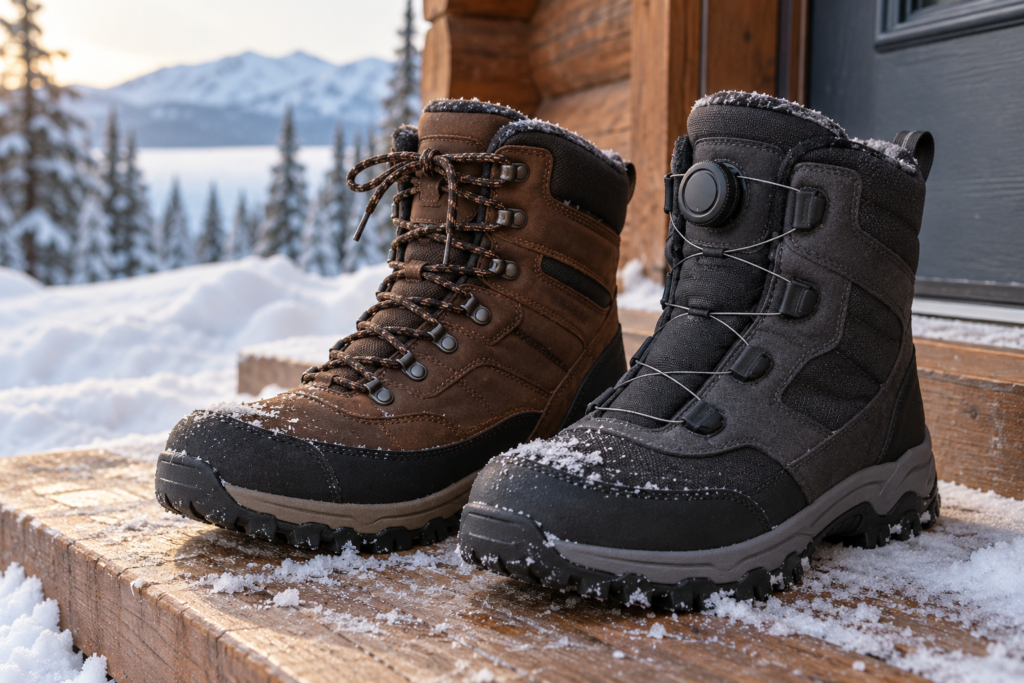
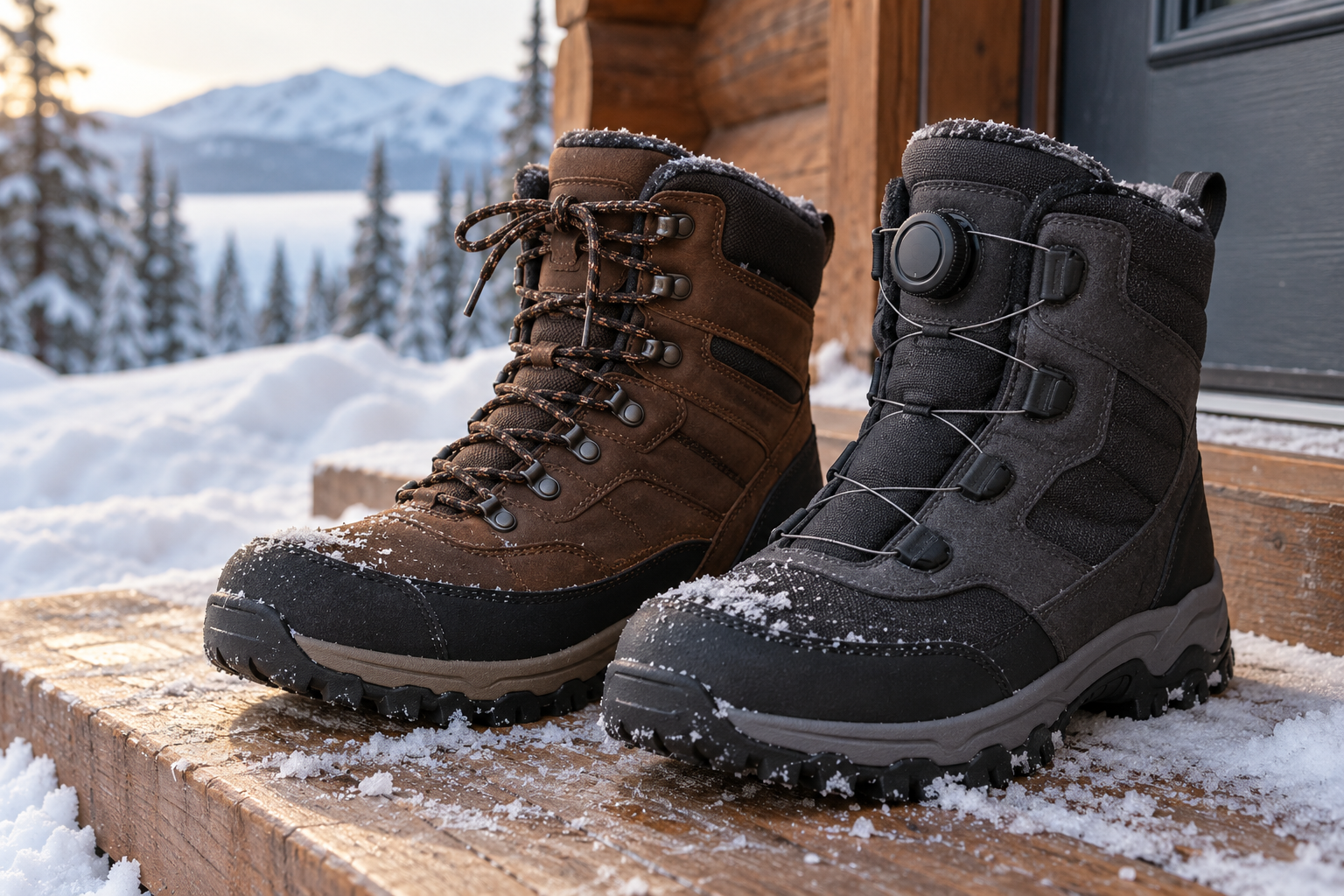
Quick verdict: Pay for BOA when the particular winter boot fits well and dial adjustment makes your routine easier. Traditional laces remain good value when you can adjust them comfortably; closure convenience should not outweigh fit, insulation, traction or a practical repair plan.
Research-based buying guide; no hands-on testing is claimed. As an Amazon Associate, Time to Get Outside earns from qualifying purchases.
| Decision | How the options compare |
|---|---|
| Main attraction | BOA closure: Dial-operated tension adjustment on compatible boots Traditional laces: Familiar adjustment and commonly available replacement laces |
| Before buying | BOA closure: Try the exact dial and boot with winter gloves Traditional laces: Check handling and fit with the intended socks |
| Replacement check | BOA closure: Correct system and model-generation kit Traditional laces: Manufacturer-appropriate lace length and type |
Buy the boot first and the closure second
A dial can make a winter boot appealing, but it does not tell you whether the heel fits, the toe box has room or the sole suits your route. Start with the complete boot’s intended job. Two boots with different closures can also differ in insulation, shaft design, waterproofing and outsole, which complicates a simple price comparison.
Try each candidate with the socks you intend to wear and use the closure while wearing your usual gloves. Check how easily you can adjust and release it, as well as how the boot feels when walking. A convenience feature is worth paying for only when it improves a boot that already fits the task.
What a BOA winter boot offers
Korkers’ current Snowmageddon BOA listing identifies an M4 fit system. It provides a concrete example of dial-operated adjustment in a winter boot, not evidence that every dial boot has the same fit or parts. Read the exact listing because older generations and other product families can use different systems.
The attraction is making tension adjustments through the dial rather than repeatedly tying a conventional knot. That can be useful for frequent changes during an outing. Whether it is easier with your particular gloves is something to check directly; neither the dial nor its price establishes how comfortably pressure is distributed on your foot.
Why ordinary laces can still be enough
Traditional laces are a reasonable choice when you can fasten and adjust them comfortably and the boot holds your foot as intended. They also give you a familiar replacement item to check before a trip. Match any spare to the manufacturer’s appropriate length and type rather than assuming every cord is suitable.
A lace-up boot should not be dismissed as an outdated purchase simply because a dial alternative exists. If both options suit the job, compare the Canadian-dollar price difference against the convenience you will actually use. Spending more on the closure can be poor value when another suitable boot fits better or leaves room for necessary winter equipment.
Check the repair system before checkout
BOA replacement parts are system-specific. Korkers’ FAQ distinguishes current and older winter-boot hardware, so identify the actual model generation before ordering a kit. A spare chosen for a different BOA product is not automatically compatible. Read the supplied replacement instructions instead of assuming conventional shoelaces can substitute inside a dial system.
BOA’s guarantee concerns its covered components under the stated terms, rather than a blanket warranty on the whole boot. My recommendation is a dial when its adjustment suits you and the complete boot earns the cost. Keep traditional laces when they work well, and compare fit, outsole, insulation and serviceability before paying a premium for either closure.
Compare current U.S. and Canadian listings
These buttons open product searches, not guaranteed stock or fixed prices. Match the exact model, size, included accessories and seller before ordering. Canadian shoppers should compare the final cost in Canadian dollars, including any shipping or import charges.
Related buying guides
- Hiking Gaiters vs Waterproof Boots: What Keeps Feet Drier?
- Best Boot Dryers for Wet Winter Boots and Shoes
- Short vs Tall Hiking Gaiters: Which Height Should You Buy?
Sources and research notes
Specifications and guidance checked October 15, 2026. Recommendations are editorial judgments based on the cited details and use cases; they are not independent performance measurements.