
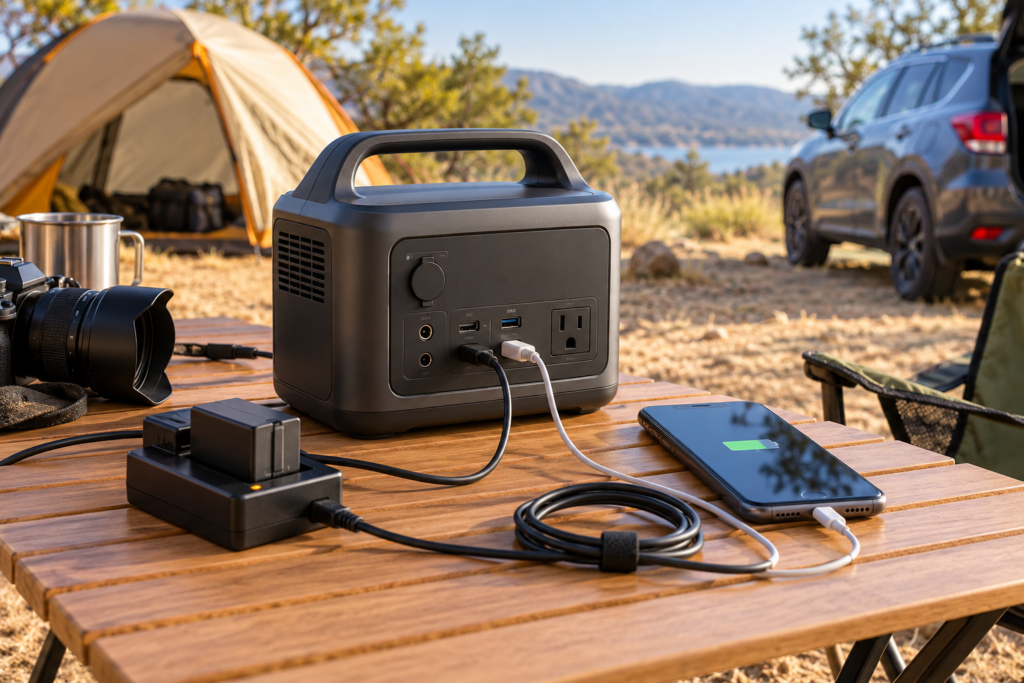
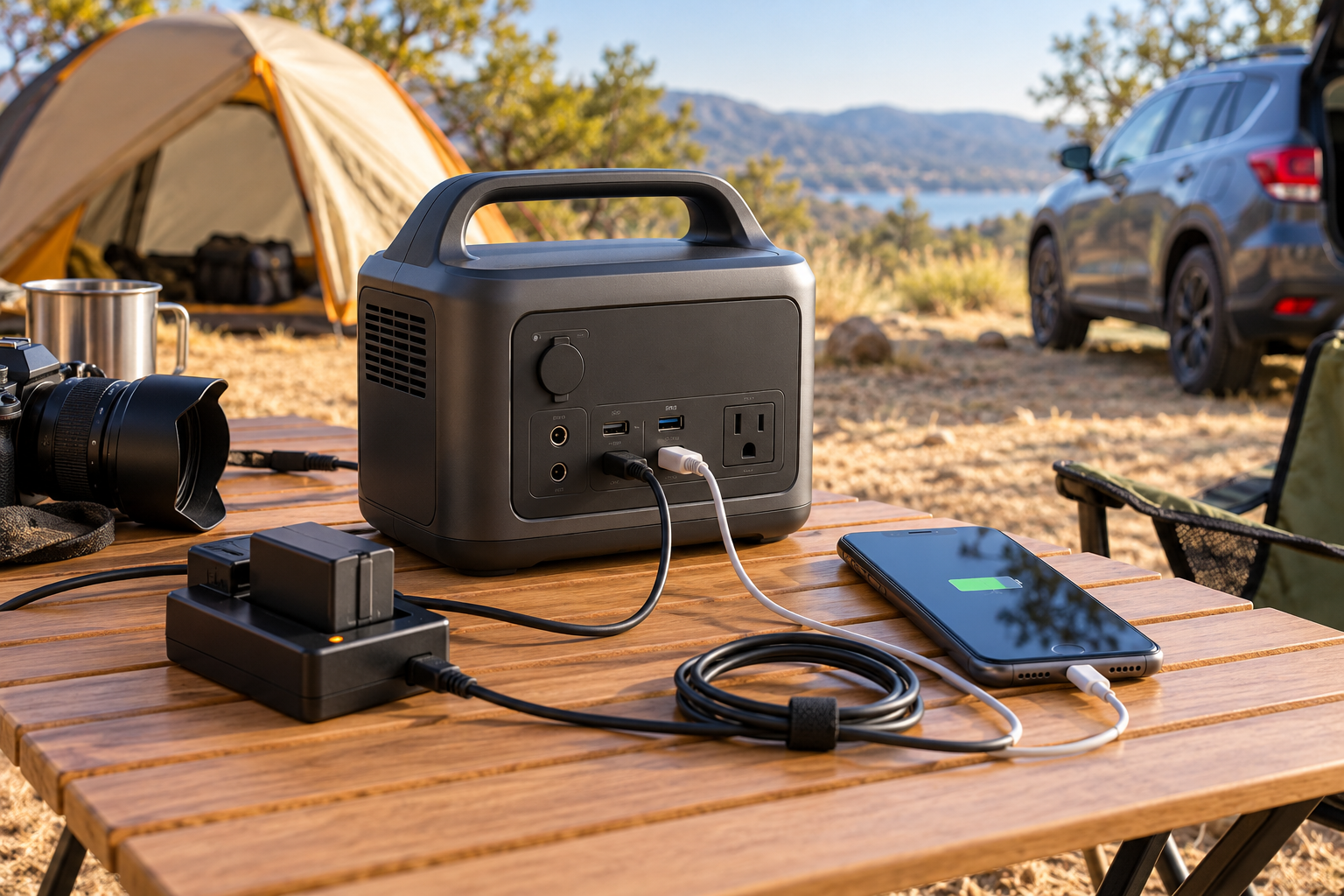
Quick verdict: Buy the C300 DC for a kit built around USB and compatible DC devices. Pay for the C300 when you genuinely need its AC outlets. Both list 288Wh capacity, so the AC model is an outlet upgrade, not a bigger battery.
Research-based buying guide. No hands-on testing is claimed. As an Amazon Associate, Time to Get Outside earns from qualifying purchases.
| Decision | SOLIX C300 DC | SOLIX C300 |
|---|---|---|
| Listed battery capacity | 288Wh | 288Wh |
| AC outlets | No | Yes; 300W rated AC output |
| Charging consideration | USB-C charger requirements matter | Direct AC charging available |
| Better buying trigger | USB-powered travel electronics | A necessary device with an AC plug |
Make a list of plugs before comparing deals
Write down every item you expect to power: phone, camera charger, laptop, light and anything with a wall plug. Then check what each device actually accepts. A USB-C socket does not by itself guarantee the required charging profile, and a laptop’s original AC adapter may be only one of its charging options.
If your essentials all accept compatible USB or DC power, buying an AC inverter can add cost without solving a problem. If one essential charger genuinely requires AC, the C300’s outlets make the comparison much simpler. Do this inventory before buying a new station and discovering that a key adapter will not fit your plan.
Same battery capacity, different output flexibility
Anker lists 288 watt-hours for both stations. The C300 DC is the DC-only version; the C300 adds AC outlets rated at 300 watts. Capacity describes stored energy, while watts describe power delivery. A 300W label is not a promise that the unit can deliver 300 watts for 288 hours.
For a rough planning example, a hypothetical 20-watt load running for ten hours needs 200 watt-hours before conversion losses and other overhead. That arithmetic is useful for sizing a trip, but it is not a measured runtime for either station. Leave margin and check the real power demand of your equipment.
Include the charger in your actual purchase cost
The Canadian C300 DC listing includes a USB-C to USB-C cable. Its FAQ says a USB-C PD charger of 30W or higher is required, with two 140W charging ports needed for its full-speed dual-input charging. A cable in the box does not mean you already have the wall-power equipment needed for the fastest advertised recharge.
The C300 Canadian listing includes an AC charging cable and supports direct wall charging. For someone starting without high-power USB-C adapters, that convenience may narrow the real price difference. Compare a ready-to-use kit, not just two bare-unit sale prices.
Keep the power limits in perspective
Anker distinguishes the C300’s 300W rated AC output from its SurgePad claim. Do not use a higher promotional figure as permission to run any appliance whose label exceeds the rated continuous output. Read the compatibility guidance for the specific load rather than treating all AC appliances as equivalent.
For a weekend electronics kit, the more useful question is whether you have enough energy for repeated charges and a suitable way to refill the station. Solar panels are optional equipment, not included simply because the product name says SOLIX. Panel compatibility and weather also matter; neither station turns a short cloudy stop into guaranteed full charging.
Who should buy—and who should skip?
Choose SOLIX C300 DC: You have compatible USB/DC equipment and already own suitable charging hardware, or have included that hardware in the budget.
Choose SOLIX C300: You need an AC-only charger or place a high value on plugging the station directly into the wall to recharge.
Skip the purchase: A smaller power bank covers the trip, or your essential appliance needs more continuous power or battery capacity than these units provide.
Final buying recommendation
The C300 DC is the focused choice for USB-based travel electronics. The C300 earns its premium when AC compatibility or direct AC recharging removes a recurring hassle. I would not buy the AC model simply expecting longer runtime: the listed battery capacity is the same.
Compare U.S. and Canadian listings
These buttons open product searches. Match the exact model, size, generation, seller and included accessories; they do not guarantee stock or a fixed price. Canadian shoppers should compare the final total in Canadian dollars, including shipping and any import charges.
Related outdoor buying guides
Sources and research notes
Product details checked October 16, 2026. Specifications and limits below come from the manufacturers; buying recommendations are editorial judgments, not independent performance measurements.