
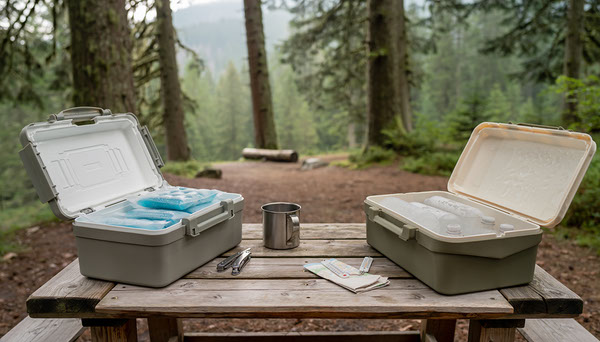
Quick verdict: Choose an ice cooler for occasional trips when ice access and packing space are manageable. Choose a 12V compressor fridge for frequent trips when a dependable power system is already available or worth buying. A thermoelectric cooler is a different product category.
Research-based buying guide; no hands-on testing is claimed. As an Amazon Associate, Time to Get Outside earns from qualifying purchases.
| Decision | How the options compare |
|---|---|
| Cooling source | 12V compressor fridge: Powered compressor system Ice cooler: Ice or cold packs inside insulation |
| Extra planning | 12V compressor fridge: Power, ventilation and vehicle connections Ice cooler: Ice replacement, meltwater and space for cooling material |
| Best purchase case | 12V compressor fridge: Repeated trips with a suitable power plan Ice cooler: Simple occasional trips with accessible ice |
| Temperature check | 12V compressor fridge: Verify actual food temperature Ice cooler: Verify actual food temperature |
Confirm which powered technology you are buying
A 12V plug does not prove that a cooler contains a compressor. Dometic distinguishes compressor, thermoelectric and passive cooling systems. A cheap thermoelectric box should not be treated as equivalent to a compressor refrigerator simply because both connect to a vehicle.
This comparison is specifically between a compressor fridge and an insulated ice cooler. The fridge actively cools while power is available. The passive cooler relies on a sufficient cold reserve and insulation. Both need sensible packing and temperature checks when used for perishable food.
When an ice cooler is the better buy
For a few short trips each year, an existing cooler and an appropriate ice plan can be hard to beat. There is no cable route to manage, no compressor ventilation requirement and no extra battery to recharge. The container can also remain useful when your destination has no electrical supply.
Its capacity must accommodate both food and the cooling material. Compare usable food space rather than treating two containers with the same nominal volume as equal. Include ice availability and any need to drain or contain meltwater in your routine.
When the compressor fridge becomes worthwhile
Frequent road trips can make active temperature control attractive, especially when buying ice is inconvenient. A fridge can use its compartment without a large volume of ice, but it brings its own power and ventilation requirements. Read the exact model’s instructions for clearances and permitted mounting.
Do not assume a vehicle socket remains powered when parked, or that a low-voltage cutout guarantees the vehicle will always start. Check the vehicle and fridge instructions. A separate suitable power source may be part of the ownership cost rather than an optional luxury.
Calculate cost per trip honestly
Add the fridge, any appropriate battery, cables and charging equipment before comparing it with an ice cooler. Then consider how many trips you actually take and the inconvenience you want to remove. There is no universal payback period; local ice prices, trip length and existing equipment change the calculation.
If you already own a suitable power system, the fridge purchase is a different proposition from starting with nothing. If you mostly camp beside a powered site and use only a small food supply, a simpler cooler may still be sufficient.
Food safety applies to both
Health Canada advises keeping perishable food at or below 4°C. Use a suitable thermometer to verify conditions rather than judging by a cool-feeling wall or the presence of unmelted ice. A fridge display is helpful, but packing and the location of the sensor can affect what it tells you.
Keep raw food securely contained, manage repeated openings and follow current food-storage guidance. If power is interrupted or the cold reserve runs out, reassess the food using official guidance rather than assuming an expensive container makes it safe.
Final buying recommendation
Buy ice-cooler simplicity for occasional trips; buy compressor convenience when repeated use supports the complete power cost. Start by fixing packing or temperature-monitoring problems in the equipment you own. Upgrade when active cooling solves a recurring need you can support reliably.
Compare current U.S. and Canadian listings
These buttons open product searches, not guaranteed stock or fixed prices. Match the exact model, size, included accessories and seller before ordering. Canadian shoppers should compare the final cost in Canadian dollars, including any shipping or import charges.
Related buying guides
- Best 12V Portable Fridges for Camping and Road Trips
- Soft Cooler vs Hard Cooler for Weekend Car Camping
- Cooler Ice Packs vs Frozen Water Bottles for Camping
Sources and research notes
Specifications and guidance checked October 15, 2026. Recommendations are editorial judgments based on the cited details and use cases; they are not independent performance measurements.