
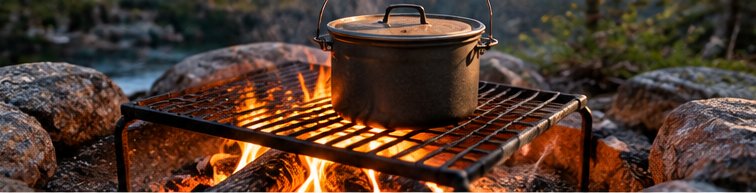
Quick verdict: Buy a suitable skillet first for ordinary frying and searing. Buy a camp Dutch oven when covered pot meals or coal-heated baking are part of your planned menu. Compare cookware with your actual heat source, lifting ability and campsite fire rules.
Research-based buying guide; no hands-on testing is claimed. As an Amazon Associate, Time to Get Outside earns from qualifying purchases.
| Decision | How the options compare |
|---|---|
| Main cooking role | Camp Dutch oven: Covered pot cooking and appropriate baking Cast iron skillet: Open-pan frying and searing |
| Design to check | Camp Dutch oven: Legs, lid and bail handle on camp models Cast iron skillet: Handle clearance and cooking-surface size |
| Extra equipment | Camp Dutch oven: Suitable lid handling and permitted heat arrangement Cast iron skillet: Suitable heat protection and cooking support |
| Worth owning first? | Camp Dutch oven: If the menu needs a covered camp oven Cast iron skillet: Usually the simpler first pan for basic meals |
Let the menu choose the cookware
A camp Dutch oven and a skillet can both be cast iron, but their shapes suit different meals. A shallow open pan makes sense for frying. A deeper covered vessel makes sense for dishes that need contained volume or a suitable baking arrangement. Buying both before planning a menu adds weight without proving either will be useful.
Lodge’s camp Dutch oven has legs, a bail handle and a fitted cast-iron lid. Its standard skillet has a flat cooking base and an open-pan design. Check the exact model: a household Dutch oven, a camp oven and an enamel-coated pot should not be assumed to share every permitted heat source.
When the skillet should come first
A skillet is a practical first purchase if your usual meals are eggs, vegetables, pancakes or food you want to sear. Choose enough cooking surface for your normal portions rather than the largest pan available. A very broad skillet can overwhelm a small stove or leave the outer area poorly heated.
Measure the stove’s pan support and read its cookware limits. The pan’s long handle must sit safely without blocking another burner or projecting into a walkway. A suitable existing pan may already do this job, especially if you cook beside the vehicle only a few times each year.
When a camp Dutch oven earns its weight
A camp oven is worth considering for covered dishes or baking you genuinely plan to prepare. Its lid and legs can support a different outdoor cooking arrangement from a flat-bottom pot, but only within the maker’s instructions and the site’s permitted setup.
Do not assume a legged camp oven fits securely on your tabletop stove. Include appropriate lid handling, heat protection and transport storage in the budget. Practice lifting the empty cookware safely before deciding how manageable it will be once food is inside.
Fire rules can change the purchase
If your cooking plan depends on coals or a campfire, check the campground’s current restrictions before the trip. Owning a camp oven does not grant permission to use a prohibited heat source. Keep an appropriate alternative meal and cooking plan when local conditions require it.
Cooking gear and combustion equipment belong in their permitted outdoor setup with suitable clearances. A heavy pot does not make an unstable support safe. Let cookware cool before packing and protect nearby surfaces from hot handles and lids.
Cleaning is part of the value
Cast iron needs a routine that works with your campsite’s washing arrangements. Follow the manufacturer’s cleaning guidance, dry it thoroughly and maintain the seasoning as directed. Lodge permits appropriate washing; the idea that cast iron must remain dirty to preserve its finish is not a useful buying principle.
Think about transport too. A dedicated protective spot can keep a heavy pan from rubbing other equipment. Canadian buyers should compare shipping charges on bulky cookware and avoid importing a large oven if a suitably sized local option meets the menu.
Final buying recommendation
Start with a skillet for simple pan meals; add a camp Dutch oven for a specific covered-cooking plan. Keep working cookware if it fits the stove and the food you make. Buy the second vessel when it adds meals you will cook, rather than merely completing a matching set.
Compare current U.S. and Canadian listings
These buttons open product searches, not guaranteed stock or fixed prices. Match the exact model, size, included accessories and seller before ordering. Canadian shoppers should compare the final cost in Canadian dollars, including any shipping or import charges.
Related buying guides
- Best Camp Cookware Sets for Easy Campsite Meals
- Stainless Steel vs Aluminum Camping Pots: Which Should You Buy?
- Heat-Resistant Grill Gloves vs Work Gloves for Camp Cooking
Sources and research notes
Specifications and guidance checked October 15, 2026. Recommendations are editorial judgments based on the cited details and use cases; they are not independent performance measurements.