
Disclosure: As an Amazon Associate, Time to Get Outside earns from qualifying purchases. Product features, app compatibility, regional availability, and prices can change.
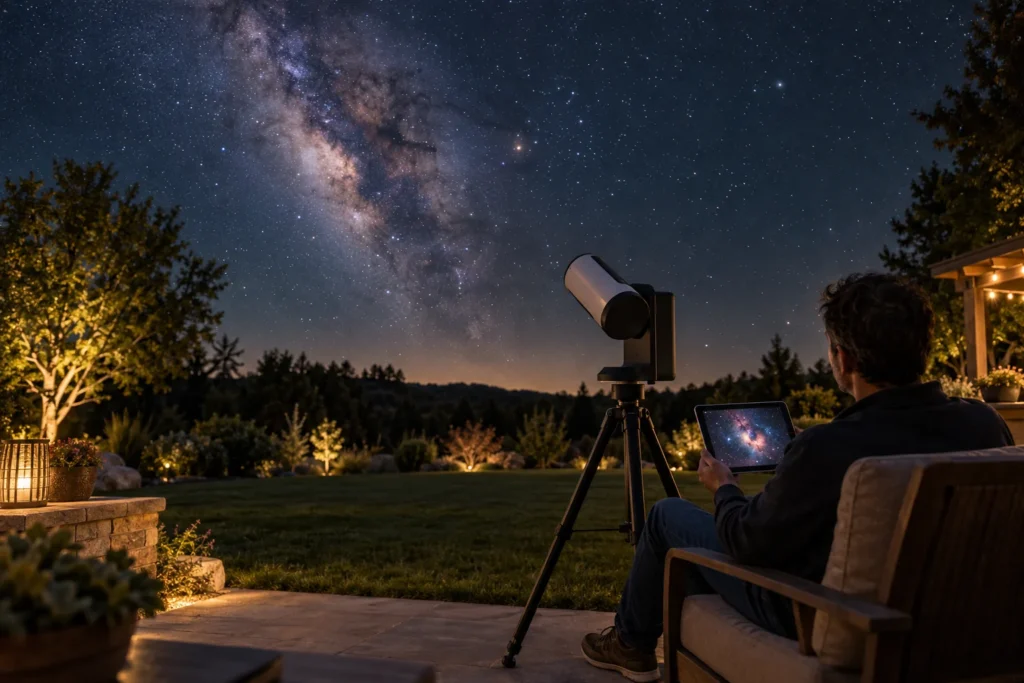
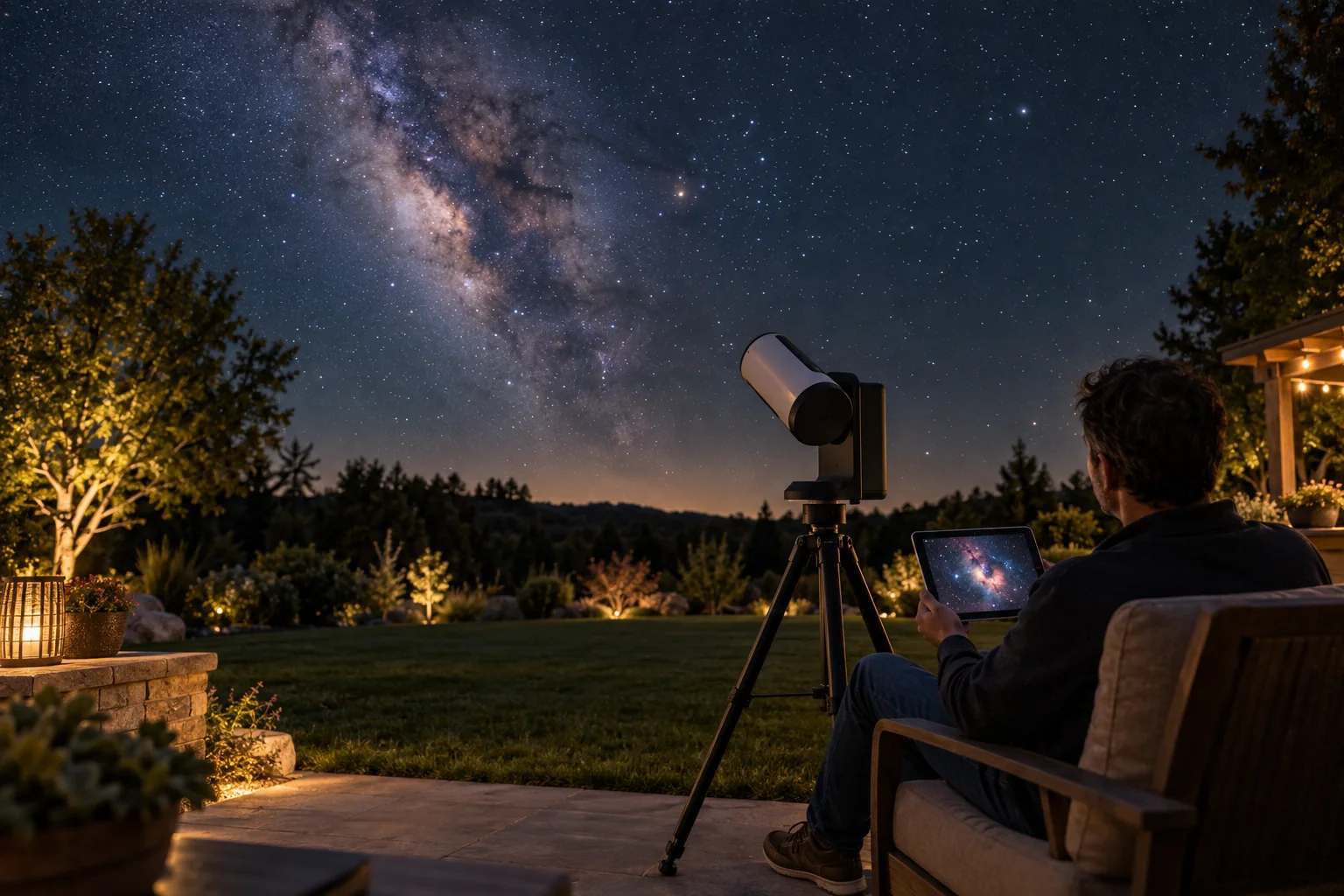
A traditional telescope can deliver an unforgettable view, but first-time owners often discover a steep learning curve: aligning the mount, finding a target, focusing in the dark, and keeping the object in view as Earth turns. A smart telescope handles most of that work automatically. Set it outside, connect a phone or tablet, choose a galaxy, nebula, star cluster, or the Moon, and the telescope finds, tracks, photographs, and gradually reveals it on your screen.
The newest models make backyard astronomy feel less like operating specialized equipment and more like opening a window into the night sky. The important part is choosing the right kind. A compact 30mm system excels at travel and wide Milky Way scenes; a 50mm model gathers more light for detailed deep-sky targets; and a premium six-inch observatory can produce a different level of image in far less time.
Quick verdict
Best overall: The Seestar S50 Pro combines a useful 50mm aperture, an 8.3-megapixel telephoto sensor, a second wide-angle camera, built-in filters, automatic targeting, and an approachable all-in-one design.
Best value and Milky Way versatility: The Seestar S30 Pro is lighter and wider, with dedicated Milky Way, star-trail, panorama, solar-system, and deep-sky modes.
Best lightweight travel option: The DWARF 3 weighs about 1.3 kg, includes three built-in filters and a solar filter, and doubles as a telephoto camera for nature and scenery.
Best premium backyard observatory: The Celestron Origin Mark II uses a fast six-inch RASA optical system, an 8.3-megapixel camera, automatic alignment, active dew control, and real-time image stacking.
Smart telescopes compared
| Telescope | Best for | Main optics | Weight | Main tradeoff |
|---|---|---|---|---|
| Seestar S50 Pro | Best overall | 50mm f/5.2 APO plus wide camera | 2.8 kg | Costs more and weighs more than compact models |
| Seestar S30 Pro | Milky Way and value | 30mm f/5.3 APO plus wide camera | 1.65 kg | Smaller aperture for faint compact targets |
| DWARF 3 | Travel and multipurpose use | 35mm telephoto plus wide camera | 1.3 kg | More technique and app learning than Seestar |
| Celestron Origin Mark II | Premium image quality | 152mm f/2.2 RASA | 18.9 kg assembled | Premium price and limited portability |
1. Seestar S50 Pro — best overall
The S50 Pro is the strongest all-around recommendation because it balances serious deep-sky capability with the simplicity people expect from a smart telescope. Its 50mm four-element apochromatic lens gives it more light-gathering ability than the compact 30mm and 35mm alternatives, while its 8.3-megapixel telephoto camera records galaxies, nebulae, and star clusters at a much higher resolution than the original S50.
A second wide-angle camera helps with automatic navigation and opens the door to broad night-sky compositions. Built-in UV/IR-cut, dual-band light-pollution, and dark-frame filters reduce the amount of extra gear needed. The included tripod, protective case, solar filter, and USB-C cable make it a complete package rather than the beginning of an accessory hunt.
This is still a sealed smart telescope, not a modular astrophotography rig. Its convenience comes from letting the app control targeting, tracking, autofocus, live stacking, mosaics, and processing. Owners who eventually want interchangeable cameras, focal reducers, or a conventional eyepiece will outgrow that design. Most beginners, families, and backyard photographers will appreciate not having those complications in the first place.
- Buy it for: the best mix of aperture, resolution, automation, filters, and manageable size.
- Watch for: a higher price and 2.8 kg body compared with the smaller smart telescopes.
- Best buyer: someone who wants impressive deep-sky results without building a separate mount, camera, computer, and guiding system.
2. Seestar S30 Pro — best value and Milky Way versatility
The S30 Pro is not simply a smaller S50. Its dual 4K cameras are designed to cover two different views: a 30mm telephoto system for deep-sky targets and a 63-degree wide-angle view for the Milky Way, constellations, landscapes, star trails, and time-lapse sequences. The app can separate the stationary foreground from the tracked sky and automatically stitch a wide panorama up to 8K.
At about 1.65 kg, it is easy to carry to a darker park, campsite, lakeshore, or rural pull-off. The telescope can connect directly to a phone through its own Wi-Fi after initial setup, so an internet connection is not required in the field. Battery life is typically enough for a full evening, and owners who add a compatible equatorial head can use longer exposures with less field rotation.
The compromise is aperture. A 30mm lens cannot collect as much light or resolve small distant objects as a 50mm or six-inch system. The S30 Pro earns its place through creative flexibility: it is the better choice for a buyer who wants the Milky Way over a landscape as often as a close view of a nebula.
- Buy it for: 4K dual cameras, one-tap Milky Way imaging, star trails, panoramas, low weight, and strong value.
- Watch for: less reach on faint, small deep-sky targets and no support for interchangeable filters or cameras.
- Best buyer: a traveler, camper, or outdoor photographer who wants a smart telescope and a wide night-sky camera in one device.
3. DWARF 3 — best lightweight travel option
The DWARF 3 takes a broader approach to outdoor imaging. Its telephoto and wide-angle cameras can photograph the Sun with the included magnetic solar filter, the Moon, nebulae, galaxies, birds, wildlife, and daytime scenery. At roughly 1.3 kg, it is the lightest option here and slips into a backpack more easily than a conventional telescope and tracking mount.
Its 35mm telephoto aperture, 4K Sony sensor, 128 GB of internal storage, 10,000 mAh battery, and three built-in filters create a capable little field system. The dual-band filter isolates important nebula wavelengths and helps cut through some moonlight and urban glow. In equatorial mode it can use exposures up to 60 seconds, and measured astronomy battery life can reach about 5.5 hours in mild conditions.
DWARF 3 rewards owners who enjoy experimenting. Its panorama, astro, solar, lunar, birding, and tracking functions cover a lot of ground, but that versatility also means more menus and more choices. The most effortless first night may belong to a Seestar; the most adaptable travel companion may be the DWARF.
- Buy it for: minimum weight, solar filter, generous storage, long battery life, and crossover use for nature photography.
- Watch for: the smaller aperture and a workflow that can require more learning and fine-tuning.
- Best buyer: a curious outdoor photographer who wants one compact device for both daytime subjects and the night sky.
4. Celestron Origin Mark II — best premium backyard observatory
The Origin Mark II sits in another class. Its 152mm Rowe-Ackermann Schmidt Astrograph gathers far more light than the portable models, and its fast f/2.2 optics feed a modern 8.3-megapixel Sony color sensor. That combination reveals faint structure quickly, allowing galaxies and nebulae to build on the screen through live stacking without the owner assembling a traditional imaging rig.
Setup is remarkably approachable for such a capable instrument. Place the three sections outside, turn it on, connect the app, and StarSense technology automatically focuses and aligns the system. The telescope includes a full-height tripod, internal computer, motorized mount, rechargeable battery, environmental sensor, dew heater, and removable shield. Multiple people can watch the live view on their own devices or cast it to a television.
The premium price buys speed, aperture, serviceable components, interchangeable 1.25-inch and 2-inch filters, downloadable raw data, and room to grow. It does not buy portability. The assembled system weighs about 41.6 pounds, so it suits a patio, deck, or backyard far better than a hike. It is also an expensive purchase for someone who has not yet discovered whether astronomy will become a lasting hobby.
- Buy it for: six-inch light gathering, very fast optics, automatic alignment, dew control, raw files, removable filters, and upgrade potential.
- Watch for: premium cost, several-piece setup, and an assembled weight near 19 kg.
- Best buyer: a committed backyard observer who wants near-observatory performance with consumer-friendly automation.
Choose the right smart telescope in 30 seconds
- I want the safest all-around choice: Seestar S50 Pro.
- I care most about Milky Way landscapes and easy travel: Seestar S30 Pro.
- I also photograph birds, wildlife, and scenery: DWARF 3.
- I want the strongest deep-sky system and have the budget: Celestron Origin Mark II.
- I mainly want to look through an eyepiece: choose a traditional visual telescope instead; these models are built around a camera and screen.
What a smart telescope actually does
A smart telescope combines optics, a digital camera, motorized tracking, autofocus, a sky database, and image-processing software. After it identifies its position, it points itself toward the selected object and captures a sequence of short exposures. The app aligns and stacks those frames in real time. With each useful frame, faint detail and color become easier to see while random noise is reduced.
That is why a nebula on the tablet can look more colorful than it appears through a visual telescope. The system is accumulating light over time; it is not merely magnifying a live eyepiece view. Processing can sharpen, stretch, and balance the real captured data, but it cannot replace clear sky, correct focus, sufficient exposure time, or a target that is above the horizon.
Set realistic expectations before buying
Planets are not the main attraction
Compact smart telescopes are excellent for large deep-sky objects, the Moon, the Sun with the correct supplied filter, and wide celestial scenes. Jupiter and Saturn can be recorded, but they appear small compared with images from long-focal-length planetary equipment. Buy one for nebulae, clusters, galaxies, lunar detail, and shareable astrophotography—not for a giant live view of Saturn.
Light pollution still matters
Built-in filters and stacking make suburban astronomy much more practical, but darker skies still improve contrast and reduce processing time. Turn off nearby patio lights, move out of direct streetlight glare, and choose targets high above the horizon. A modest telescope under a dark sky can outperform a larger one beside bright exterior lighting.
Clouds, wind, and dew still win
Automation cannot photograph through cloud, stop a light tripod from shaking, or keep every exposed lens dry. Check the forecast, use a stable surface, keep the equipment away from sprinklers, and allow the telescope to acclimate when moving between a warm house and cold air. Never pack it away damp.
Four specifications that matter most
- Aperture: a wider opening gathers more light and usually reveals faint targets faster. It also increases size, weight, and price.
- Field of view: a wide field fits large nebulae, star fields, and the Milky Way; a narrower field makes smaller targets appear larger.
- Filters: light-pollution and dual-band filters can dramatically improve emission nebulae, but they are not the right tool for every galaxy or star cluster.
- Portability: the telescope that is easy to carry outside will often capture more nights than the technically superior system that feels like a project.
Build the rest of the evening around comfort and curiosity. A heated camping chair can extend cool-weather sessions, while our guides to backyard projectors, smart bird feeders, and creating a backyard you actually use offer more ways to enjoy the space in every season.
Safety: never improvise when observing the Sun
Never aim any telescope, camera, binocular, or optical device at the Sun unless the exact model has the manufacturer-approved solar filter installed correctly over the front aperture. Permanent eye damage and equipment damage can happen quickly. Inspect the filter for damage before every solar session, follow the supplied procedure, supervise children, and do not substitute eclipse glasses, photographic filters, tinted plastic, or homemade material.
A camera-based smart telescope reduces the temptation to look through an eyepiece, but the optical system can still be damaged by unfiltered sunlight. When in doubt, keep the telescope indoors until you have the correct filter and instructions.
Frequently asked questions
Can I see through a smart telescope with my eye?
Usually not. These all-in-one models send the camera view to a phone or tablet instead of using a traditional eyepiece. That makes them easy to share with a group and ideal for saving images, but buyers who want a purely visual experience should choose a conventional telescope.
Do smart telescopes work without internet service?
Most can connect directly to a phone or tablet after the app and firmware are installed. Internet access helps with initial setup, updates, object information, and sharing, but a home internet connection is not normally required during a remote observing session. Confirm the current app requirements for the exact model before traveling.
Can I use one from an apartment balcony?
Yes, if the balcony has a clear section of sky, a stable floor, and no roof or railing blocking the target. Automatic alignment can struggle when only a narrow slice of sky is visible. Avoid vibrations, bright balcony lights, wind, and any location where equipment could fall.
How long does a deep-sky image take?
Bright targets begin appearing within a few minutes, while faint detail improves as useful frames accumulate. Twenty to sixty minutes is common for a satisfying first result, and advanced owners may gather data for much longer. Sky brightness, target altitude, aperture, filter choice, and weather all affect the answer.
Are the colorful images real?
They are built from light captured by the telescope. Live stacking and processing increase contrast, reduce noise, and reveal color that is too faint for human night vision to perceive easily. Results differ from a direct eyepiece view, but they are not stock images pasted over the target.
Will a smart telescope replace a traditional telescope?
Not for everyone. A smart telescope is better for automated finding, live stacking, easy photography, and group viewing on screens. A traditional telescope is better for looking directly through an eyepiece, changing optical accessories, learning manual navigation, and specialized high-magnification planetary observing.
Final winner
The Seestar S50 Pro is the best smart telescope for most backyard stargazers. Its 50mm aperture, higher-resolution telephoto camera, wide companion camera, automatic tracking, built-in filters, included tripod, and simple app create the most convincing balance of results and convenience. Choose the S30 Pro for Milky Way creativity and lighter travel, the DWARF 3 for multipurpose outdoor imaging, or the Celestron Origin Mark II when premium deep-sky performance matters more than price or portability.
Shop in the United States
Check Seestar S50 Pro on Amazon US Check Seestar S30 Pro on Amazon US Check DWARF 3 on Amazon US Check Celestron Origin Mark II on Amazon US
Shop in Canada
Check Seestar S50 Pro on Amazon Canada Check Seestar S30 Pro on Amazon Canada Check DWARF 3 on Amazon Canada Check Celestron Origin Mark II on Amazon Canada
Recommendations are based on current manufacturer specifications, product design, intended use, portability, feature set, and buyer value. Time to Get Outside did not claim hands-on testing of these four telescopes. Confirm the exact model, regional version, app compatibility, included accessories, warranty, and seller before ordering.