
Disclosure: As an Amazon Associate, Time to Get Outside earns from qualifying purchases. Product specifications, connectors, compatibility, included cables, availability and prices can change.
A portable solar panel does not create guaranteed power just because the box carries a large wattage number. Sun angle, shade, temperature, cable losses and the charging limits of the connected power station all change what reaches the battery.
The useful question is whether the panel fits the charging system already owned, packs into the available vehicle space and can be repositioned through the day. I would choose a compatible, manageable panel before buying the largest rating that can be carried.
Compatibility comes before the wattage label
My leading choice: The Jackery SolarSaga 100 is the straightforward choice for many car campers who want an easy folding panel for a compatible portable power station.
Best weather-minded design: EcoFlow’s 110W panel balances portable output with a construction intended for outdoor use.
Best polished portable design: The Anker SOLIX PS100 is a tidy option for buyers building around a compatible Anker charging system.
Best established modular option: Goal Zero’s Nomad 100 suits campers already invested in that company’s cables, batteries and accessories.
Four portable solar panels compared
| Panel | Best role | Main advantage | Tradeoff |
|---|---|---|---|
| Jackery SolarSaga 100 | best straightforward power-station companion | Simple folding setup and broad familiarity | Best experience is usually within its own ecosystem |
| EcoFlow 110W Portable Solar Panel | best weather-minded folding option | Portable design with useful outdoor protection | Folding support and cable management take practice |
| Anker SOLIX PS100 | best polished portable design | Rigid folding sections and adjustable positioning | Connector compatibility must be checked carefully |
| Goal Zero Nomad 100 | best established modular option | Durable folding format from a mature solar ecosystem | Premium price and a relatively large folded package |
Jackery SolarSaga 100: best straightforward companion
The SolarSaga 100 uses a folding format with built-in support so it can be carried in a vehicle, opened at camp and aimed toward the sun without a separate frame. It is most appealing when paired with a compatible Jackery power station because the physical and electrical connection is easier to plan.
Like every portable panel, its rated output is measured under controlled conditions. Partial shade across even part of the surface can reduce charging sharply. A cable long enough to keep the battery in shade while the panel sits in sun improves the real setup.
Why it earns a place here: It is familiar, widely supported and easy for a first solar-camping kit to understand.
Before spending the money: Confirm the exact plug, voltage range and input limit for the power station rather than assuming brand alone guarantees compatibility.
EcoFlow 110W Portable Solar Panel: best weather-minded folding option
EcoFlow’s portable panel is designed to fold for transport and open into a useful charging area. Its carry case and support arrangement help with positioning, although finding a stable angle on rough ground can take a few tries.
Outdoor protection is helpful, but no cable connection should sit in standing water and the connected battery should remain dry, shaded and ventilated according to its instructions.
Why it earns a place here: It offers a practical balance of outdoor construction, packed size and useful output for compatible EcoFlow stations.
Before spending the money: The support system is less rigid than a framed rooftop panel and must be secured in wind.
Anker SOLIX PS100: best polished portable design
The SOLIX PS100 is built as a folding panel that can be adjusted to meet changing sun angles. Its structured sections are easier to position than loose fabric-backed designs, and the package suits a planned Anker SOLIX camp setup.
Electrical compatibility still matters. Power stations accept a defined voltage and current range, and an adapter cannot make an unsuitable panel safe. Check both products’ manuals and the exact cable supplied.
Why it earns a place here: It is a clean, organized panel for campers who want matching equipment with minimal improvisation.
Before spending the money: Brand-matched convenience can cost more than a carefully researched cross-brand setup.
Goal Zero Nomad 100: best established modular option
The Nomad 100 comes from an ecosystem that has supported portable batteries, cables and solar accessories for years. It is aimed more at base camps and vehicle-supported travel than minimalist hiking.
Its modular appeal is strongest for owners who already understand Goal Zero connections or plan to expand within that system. Buyers starting from nothing need to compare the total panel, controller, battery and cable cost.
Why it earns a place here: It fits a mature off-grid product family and can anchor a deliberate longer-term setup.
Before spending the money: It is a substantial folded panel and may be excessive for charging only phones and small lights.
Match the panel to the battery input
Check the power station’s solar-input voltage range, maximum current, connector and maximum accepted wattage. A panel rated above the station’s usable input may still work in some approved configurations, but the station will not necessarily accept the full amount.
Use cables and adapters specified by the manufacturers. Avoid improvised polarity changes or damaged connectors. Solar panels can produce voltage whenever light reaches them, even before the battery is connected.
Expect less than the laboratory rating
Clouds, haze, panel temperature, imperfect angles and shadows all reduce output. Trees create moving patches of shade that can turn a productive morning setup into a weak afternoon one.
Plan energy around conservative daily input, not the best number seen for five minutes. If refrigeration, medical equipment or emergency communication depends on power, include another dependable charging method.
Set the panel safely at camp
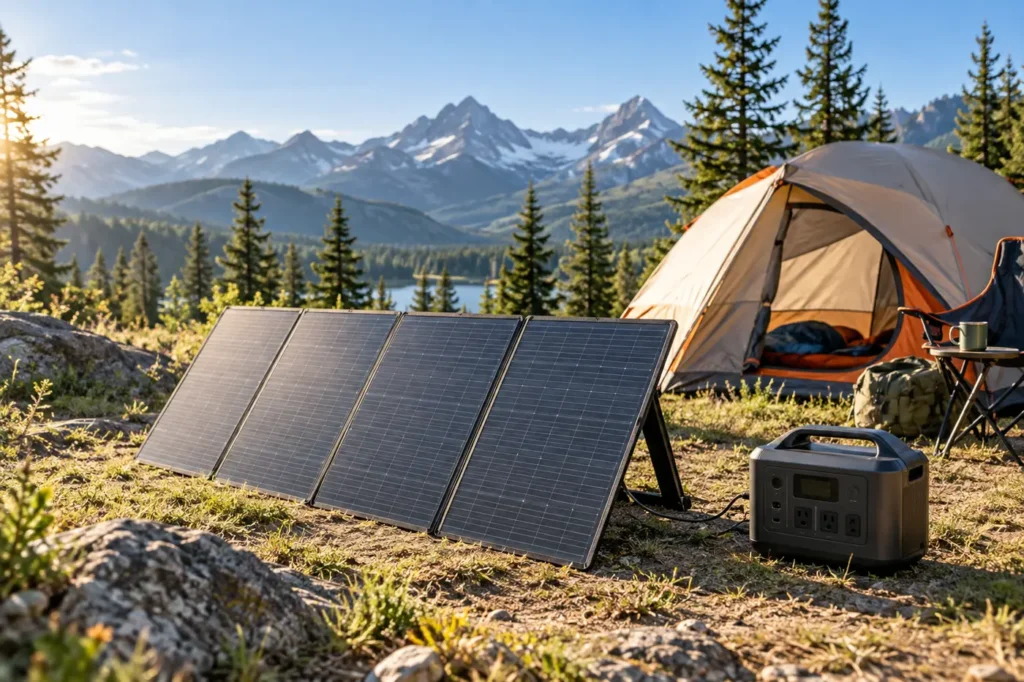
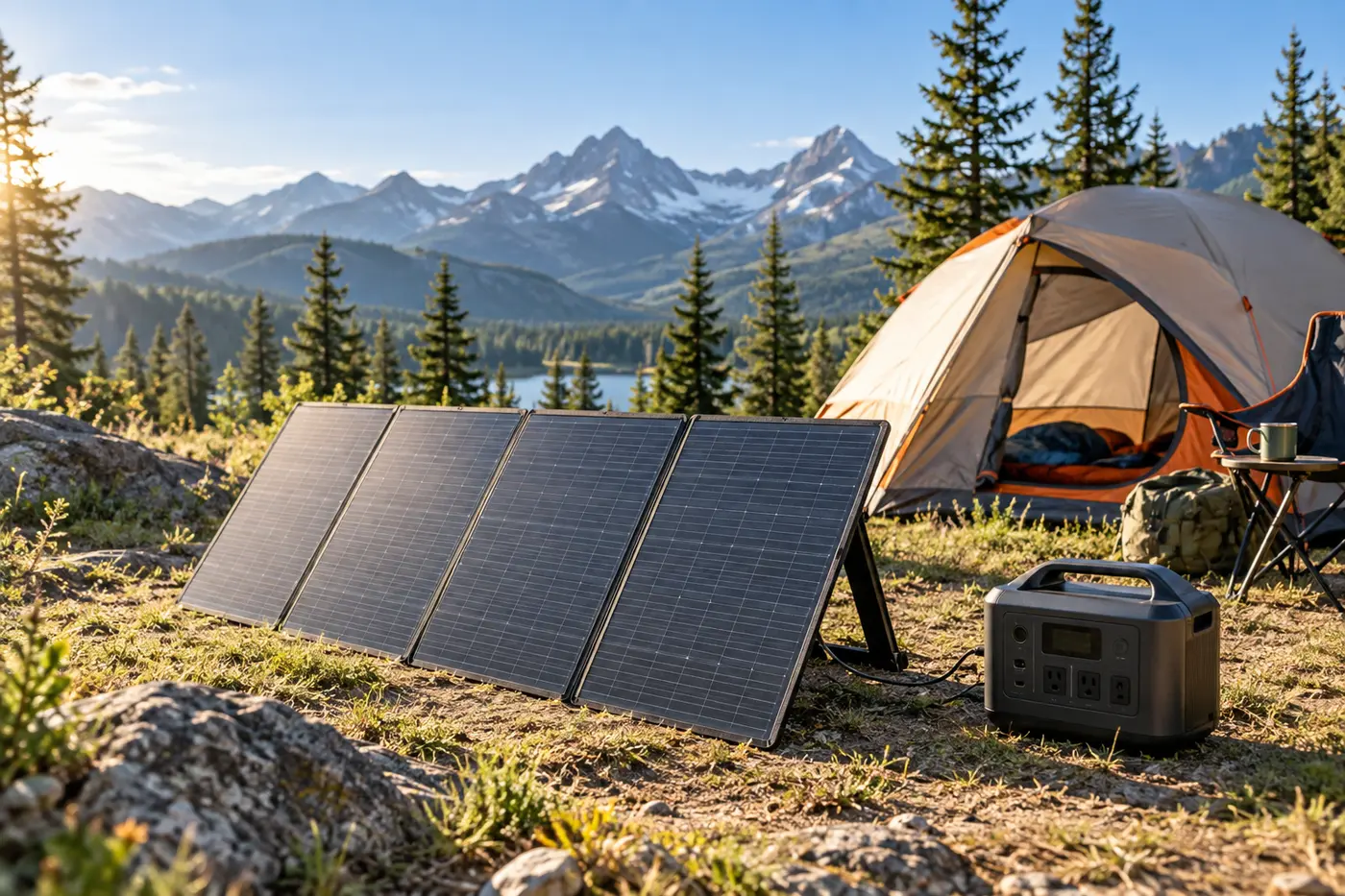
Position the panel where it receives sun without becoming a trip hazard. Route the cable along the edge of the site, keep plugs away from mud and protect the power station from heat and rain.
Portable panels catch wind. Lower or secure them before leaving camp and never place heavy rocks directly on cells. Inspect hinges, fabric, cable strain relief and connectors after every trip.
Related guides worth opening next
Continue with portable power stations for camping, 12V portable fridges and rechargeable camping lanterns. Solar makes the most sense when it supports a clearly defined group of loads.
Frequently asked questions
Will a 100-watt panel produce 100 watts all day?
No. The rating is a controlled-condition figure. Real output varies with sun, angle, temperature, shade, cable loss and the battery’s charging behaviour.
Can a solar panel charge a power station while it is being used?
Many systems support pass-through use, but limits and heat management vary. Follow the exact power-station instructions and avoid covering ventilation.
Can portable solar panels stay outside in rain?
Protection ratings differ between the panel, junction box and connectors. Do not assume the entire charging system is waterproof. Follow the maker’s weather guidance and keep the battery protected.
Is a larger panel always better?
Only if it fits the battery input, vehicle storage and campsite. A panel that is easy to carry and reposition often produces more useful energy than a larger one left folded or shaded.
📦 Buy on Amazon USA
Jackery SolarSaga 100
A familiar folding panel for topping up compatible portable power stations at camp.
Check Jackery SolarSaga 100 on Amazon USA
EcoFlow 110W Portable Solar Panel
A portable panel for campers who want a compact match for compatible EcoFlow charging systems.
Check EcoFlow 110W Portable Solar Panel on Amazon USA
Anker SOLIX PS100
A neatly packaged solar panel for compatible power stations and planned off-grid charging.
Check Anker SOLIX PS100 on Amazon USA
Goal Zero Nomad 100
A modular portable panel for established Goal Zero kits and extended base-camp use.
Check Goal Zero Nomad 100 on Amazon USA
🌄 Final Thoughts
The Jackery SolarSaga 100 is my overall choice for a straightforward car-camping setup, especially when paired with a compatible Jackery station. It is easy to understand and sized for common portable-power needs.
EcoFlow offers stronger weather-minded portability, Anker provides a polished matched-system option and Goal Zero suits buyers who value an established modular ecosystem.
Start with the battery manual, calculate the equipment that actually needs power and buy the panel that can be positioned safely. Compatibility and daily sun exposure matter more than the largest number printed on the panel.
📦 Buy on Amazon Canada
Jackery SolarSaga 100
A familiar folding panel for topping up compatible portable power stations at camp.
Check Jackery SolarSaga 100 on Amazon Canada
EcoFlow 110W Portable Solar Panel
A portable panel for campers who want a compact match for compatible EcoFlow charging systems.
Check EcoFlow 110W Portable Solar Panel on Amazon Canada
Anker SOLIX PS100
A neatly packaged solar panel for compatible power stations and planned off-grid charging.
Check Anker SOLIX PS100 on Amazon Canada
Goal Zero Nomad 100
A modular portable panel for established Goal Zero kits and extended base-camp use.
Check Goal Zero Nomad 100 on Amazon Canada
Recommendations are based on published design, portability, charging approach, compatibility and intended use. I have not claimed hands-on testing of these exact panels. Confirm current electrical specifications, connectors, included cables, weather guidance, warranty and seller before ordering.